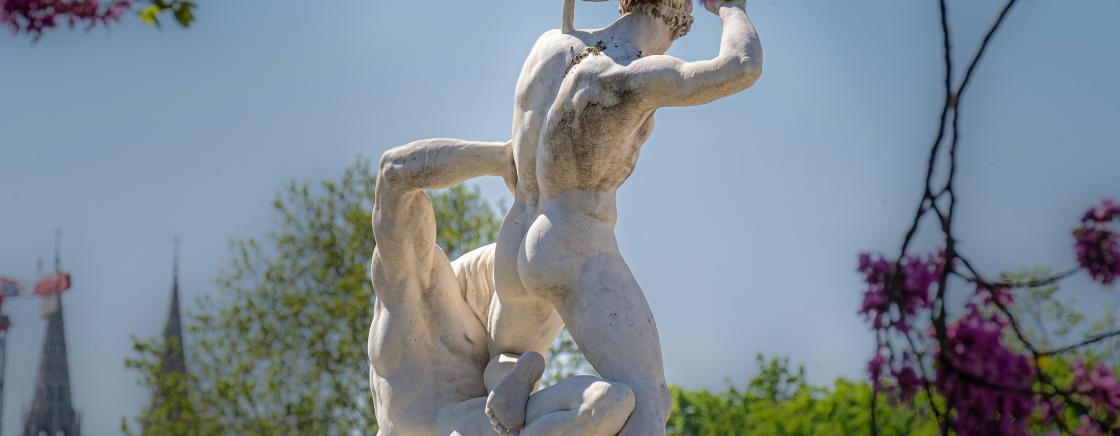
There are gardens that are not merely havens of greenery, but true museums whose ceiling is none other than the Parisian sky. The Tuileries Garden, a majestic link between the Louvre Museum and the Place de la Concorde, houses a collection of sculptures that spans centuries and artistic movements. Strolling through its avenues offers an intimate encounter with the history of statuary, from 17th-century classicism to the audacity of modern art.

Imagine your walk beginning at dawn, as the morning mist still rises from the fountains. Departing from the Rue de la Boétie, after descending the most beautiful avenue in the world and walking up the Rue de Rivoli, you enter the grounds of the Carrousel gardens. Here, the promenade begins with an immersion into the world of Aristide Maillol. Under the guidance of André Malraux in 1964, these bronze figures with generous and serene forms found their permanent showcase. Walking among these silhouettes, one feels the power of pure form, a gentle introduction to the majesty that follows.
Continuing toward the garden designed by Le Nôtre, the scenery changes and the stone comes alive. You meet the marble gaze of Roman deities and heroes of Antiquity. Replicas of masterpieces by Coysevox or Coustou impose their rigor and nobility along the royal vistas. These white marbles, catching the golden light of late Parisian afternoons, recount the myths of Olympus and allegories of time. One pauses before the Laocoon group or the nymphs of the cascade, struck by the finesse of the drapery that time has failed to alter.
The strength of the Tuileries lies in its ability to create a dialogue between these historical figures and contemporary creations. Around the corner of a grove, your gaze might be captured by César's enigmatic Welcome or the minimalist works that regularly inhabit the lawns. This tradition of artistic curation continues today through unique collaborations, particularly during the Art Basel Paris fair, where monumental sculptures by international artists transform the garden into a crossroads of global creation for the luxury and art sectors.

Approaching the Orangerie, the walk takes on a more secretive dimension. The terraces offer a unique viewpoint over the Seine and the Place de la Concorde, where the bronze of the statues seems to watch over the ceaseless flow of the capital. It is here that one understands the Tuileries Garden is a total work of art, a choreography of stone and bronze that evolves with the rhythm of the seasons and the light.

The Hôtel Monna Lisa, located just a few steps from this open-air theater, shares this passion for aesthetics and culture. Our House was designed as a tribute to art in all its forms, offering our guests a sanctuary where the decor and atmosphere recall the refinement of Parisian galleries. After an immersion among the mythical statues of the Tuileries, returning to the tranquility and sophistication of our establishment allows this enchanted interlude to linger. We invite our residents to explore this garden of a thousand faces, where each sculpture is an invitation to daydream.